


The Northern mythos has a deep understanding of how to engage wisely with the present moment. It teaches how to gain a state of personal autonomy aligned to your true purpose. While concepts like purpose and fate can seem archaic in the modern world, they are actually powerful tools for better understanding how the universe moves and how to free yourself from the hamster wheel of the past. When patterns of the past keep you chained to a life at odds with who you truly are, understanding the concepts of orlæg, wyrd and fylgja can empower you to better align to your purpose in life, so that you can do something you truly love that is beneficial to the world.
This is not wispy thinking. These ancient Northern concepts are pragmatic tools for a life on your terms. By Northern, I mean the heritage of the Anglo, Nordic and Germanic peoples, ranging from the earliest humans of Northern Europe during the Paleolithic period through to the present day, wherever on Earth such culture may be found. Anyone can make use of these concepts, regardless of background. They are an integral part of the Northern cosmology, with pragmatic implications for developing personal wisdom and self-mastery.
What is orlæg?
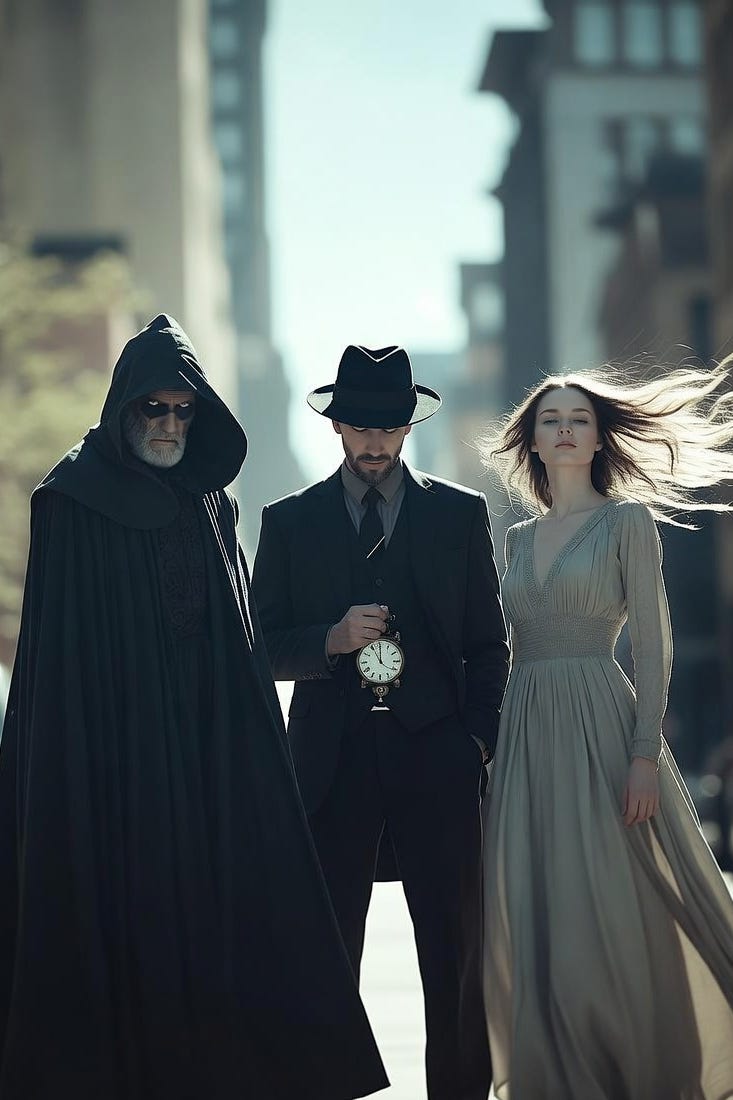
Orlæg is the accumulation of the past upon the present. It includes past actions, ancestral deeds, surrounding circumstances, and nature’s patterns. It spans from the present all the way back to the primordial origin of existence, known as Ginnungagap (‘yawning void’) in Old Norse, the ancient equivalent to the Big Bang of theoretical physics.
The word orlæg is from Old English (the Old Norse equivalent is ørlög). Its etymology is or (‘primordial, ancient, original, fundamental’) + læġ (‘that which is laid down; law’).
Orlæg is the inertial structure of the past imposing upon the present. This is not a static imposition, because the universe is dynamic; circumstances shift as life changes. As an example, if a person exercises every day, their past becomes a stable habit of strong muscle development and good health, which then exerts upon their present. But if they stop exercising for several months, they add a new layer to their past, which will then exert itself upon their present, likely resulting in poorer health, potential for injuries, and so on. In both cases the laws of nature operate upon the person’s present state, and that present state is built upon the accumulations of their past.
Orlæg is applied through natural law
Describing orlæg as the fundamental laws of the universe, in the same sense as the laws of physics or mathematics, is not entirely accurate. Orlæg is the weight of the past, which affects the present through various natural laws. It is not in itself these laws, though it operates through them. And it is not limited to the physical universe; it encompasses all existence and all experience, including also the psychological and spiritual aspects.
Orlæg is layered
Orlæg includes many layers at various scales. It includes patterns that span immense realms of space and time (such as our galaxy’s structure and its gravitational pull). It includes patterns that endure for significant times around the Earth (for example, the effects of the Industrial Revolution). And it includes more localised patterns (for example, the events of last Tuesday). All these and everything in between. A myriad layers combine in orlæg to bring about its complete effect. When examined in this way, it is infinitely complex. But put simply, it is the effect of the past upon the present.
Orlæg is both shared and unique
Orlæg applies differently to each living being or object in the universe, even while they may share many aspects of orlæg in common. Humans, for example, all share in hunger because of our common biology (a very fundamental layer of our shared human orlæg), yet each human will experience different levels of hunger in the present based on when they last ate (an effect from the more immediate past, forming part of the orlæg of each human). Or, take the example of a dog that is taught many tricks when young. It will carry that in its orlæg, giving it the foundation for actions in the present, such as sit, fetch, and roll-over. A dog not trained in such a way does not have the same foundation in place (in their orlæg) and will need to learn the tricks before it can do them. Likewise, a plant that has been cared for, with adequate water, sunlight and nutrients, will carry these patterns in its orlæg. When a frost comes, that plant may have a better chance of surviving. Finally, orlæg applies to objects as well. A well-made hammer has a different orlæg to a poorly-made hammer. When the well-made hammer hits the anvil, its orlæg ensures it will not break as easily.
To summarise, all factors of the past shape how living beings or things exist in the present. Yet the nature, habits, and circumstances of each living being or thing differ, giving each a unique orlæg, for good or otherwise.
What is wyrd?
Wyrd is existence forever becoming. While orlæg is the accumulation of the past, wyrd is centred on the present. The word is from Old English and is often linked with the Old Norse equivalent urðr (‘fate’). Its Modern English descendant, weird, echoes the ancient term in the sense of the mysteriousness of existence—how things come to be what they are is indeed strange, though we have become quite naturalised to this process.
Wyrd is a dynamic process (or web) whereby your present choices and actions add new layers to orlæg. The web metaphor highlights the interconnected nature of the universe, where one’s actions can have ripple effects. Likewise, the web suggests the past patterns (one’s orlæg) that may restrict or support one’s actions in the present. Mastering wyrd (the art of becoming in the present moment) is the key to shaping one’s destiny.
Destiny is not rigid or predetermined
While orlæg is built from the layers laid down over time—whether personal, familial, natural, or even primordial—that shape the present, there is always room for agency in the present moment. Some circumstances may appear fixed, such as the time of death or certain ancestral (genetic) patterns, but what you do matters—your decisions and actions will add to your orlæg and ripple outwards. This makes the present moment extremely powerful; wyrd is the ultimate pivot for one’s fate. And this is why awareness—being conscious in the present moment—is so important.
Orlæg and wyrd interweave
Orlæg is already built into the past, though it perpetually spills into the present. Wyrd is the centre in the present, the ‘eye of the storm’, from which all can be now shaped. While you cannot change the past, you can change the present—if you have the awareness, knowledge, and skill to do so. And how you change the present influences future possibilities. But the orlæg and wyrd of all beings and things is interwoven in various ways, like a web. This means that your actions will not only shape your circumstances but may also affect every other being or thing you interact with, in various ways. This interconnectedness highlights the art of interaction with others and the significance of different people, events, places and things for a person’s life.
Know the past to awaken the present
You always live in the present moment, never the future or the past (though the mind may wander into memory and imagination). Yet if you do not fully understand your past (your orlæg), you will likely be at odds with it in one way or another. You will be blind to its influence on your present, which will limit your ability to act upon wyrd. The same applies to understanding the past of others. Being clear-eyed about the past, but not in a fatalistic way, liberates the present. Understanding your personal history, family history, national history, global history, and other histories will give you useful maps for navigating the world in its present becoming. Similarly, being grounded in your awareness of the present, fully present in reality as it is (not as you think it is or would like it to be), is essential for acting upon wyrd to shape your destiny.

We do not clash with the present moment; we clash with the consequences of the past. Even if those consequences arise from causes microseconds prior, they are the waves of the past impacting upon the present moment. Yet the past comes at us in different ways, not always bad. It can be strengthening, supporting, and empowering for us in the present.
Unlike some Buddhist or Hindu philosophies, where the aim is to liberate oneself from all karma of the past and transcend the world, the Northern approach is more about working with the patterns of the past meaningfully—to live a meaningful life aligned with one’s destiny. The promise of paradise in a world beyond means nothing if life is not lived meaningfully here and now. The popularised Viking conception of the bright halls of Valhalla—where chosen warriors feast and drink and battle, slaying one another in glory, and repeat this anew each day—may be the ideal afterlife for some (I do wonder who?). But it’s a metaphor for how one group of people during one period in European history idealised life. I very much doubt it reflects the afterlife for everyone outside of that Viking culture. More likely, a wide range of individual and cultural values shape the various dreamscapes of the afterlife. Ultimately, the afterlife is a spiritual distillation of how you lived your life on Earth and whether you were true to your innermost self. A meaningful life on Earth, aligned to your true purpose, is more important than seeking to escape the world.
Meaningful engagement with the world means that how you respond to the effects of the past in the present is just as important as what you build in the present. As humans we are more than merely spectators and consumers. To create in alignment with your true purpose, to bring your innermost vision into the world, reflects the creative power of the universe itself. If you live in a house, that house was built in the past, yet it provides shelter in the present. And if it is a good house it will continue to do so into the future. Someone, maybe you, built that house. Likewise, what you build within yourself—the values, knowledge, skills, discipline, awareness, and so on—in the present will become your future foundation. All things are created in wyrd, in the eternal becoming of the present.
An awakened fate
The Northern mythos has a powerful understanding of fate through an aspect of the self known as fylgja (Old Norse, ‘to accompany’). While often appearing as an accompanying spirit, a spirit animal, or a guardian angel in Northern folklore, the fylgja is better understood as a part of oneself. It is that in us which brings intuitions of the future, spontaneous insights linked to a memory, gut instinct, or guidance in dreams. The fylgja, much like the Western concept of the daimon, bridges the individual with the world beyond this one and guides them to align with their true self and realise their true destiny. It is that inner voice whose instinct, intuitions, and longings shape the individual’s journey across their life, often in particularly pronounced ways at crucial times.
Many people are not particularly aware of their fylgja, hence can be said to have a sleeping fate, and may only act upon its guidance unconsciously, if ever. Those more attuned, either naturally or due to lifestyle practices, may have a subconscious fate, whose stirrings are sometimes felt, sometimes forgotten, and sometimes ignored. And those who have done the inner work will have an awakened fate; they are conscious of this aspect of themselves and actualise their destiny accordingly.
Having an awakened fate is essential for living your true purpose in the world. Indeed, the calling within you that you feel you must become is the voice of your fylgja. Many may not consider it this way, and it really doesn’t matter how you describe it. What matters is that you live it.
Your fylgja provides the intuition, foresight, wisdom and vision to live your true purpose and achieve your destiny. To achieve your destiny also requires having the right relationship with your orlæg—not being tangled in the past in a way that prevents you from achieving your vision, but instead building a past that supports you toward your destiny. It also requires mastering wyrd—having the knowledge, skills and awareness to shape the present toward your destiny.
If you look at people in the world who have actualised their dreams, they are very likely to have followed an inner calling to get to that point—it was not random luck or outside forces, although these probably played a part. (Luck is another Northern concept, perhaps for a future article.)
While orlæg relates to the past, and wyrd relates to the present, fylgja relates to the future. All three interweave to create the tapestry of your journey through life. Mastering these three brings greater capacity to engage your past so that it supports and enhances your present, to awaken your autonomy in the present moment, and to become clear about your direction moving forward.
Their fates were awakening in the style of the Elves, where clear vision and autonomy of action was the norm, rather than being forced to live through a pre-determined, externalised system, where one’s vision was limited and often the nature of the system itself was not fully known. … Most humans preferred certainty and routine over the openness and uncertainty of total freedom. And most avoided the self-discipline and self-reliance that is a prerequisite for that freedom, preferring instead reliance upon those with greater power for their needs, at the cost of their diminished freedoms.
– From Loquilian, The Alacritous Fox, by Todd William Dearing (purchase your copy here).

Disclaimer: Wizardry Sphere content and tools support the personal practice of developing wisdom and self-mastery through reflection and philosophical exploration. They are educational and inspirational in nature. Individual results vary and no specific outcomes are guaranteed. This material is not a substitute for professional advice.
www.wizardrysphere.com | Terms and conditions | Privacy policy
Copyright © 2026 Genius Authoring Pty Ltd trading as Wizardry Sphere | ABN 85 669 120 978