


Here, we explore the Northern concepts mægen and hamingja as keys to awakening greater agency and success in the world. Mægen is the Old English term for personal power. Hamingja is the Old Norse term for personal luck. These are important concepts within the ancient cultural traditions of the Anglo, Nordic, and Germanic peoples—adapted here to the current and emerging world.
This article follows from a previous article where I explored the ancient Northern concepts of orlæg, wyrd, and fylgja as keys to empower you to better align to your purpose in life. The material here avoids both scholarly pedantry and dogmatic traditionalism. Instead, I focus creatively on these ancient concepts as pragmatic tools and knowledge for self-development (see the disclaimer at the end of this article).
Mægen is personal power, strength, might, force, and vigour and encompasses one’s entire being—physical, psychological, and spiritual. Hamingja is luck, not in the modern sense of chance happenings (as I will explain soon), but as a personal force that can be cultivated. Mægen and hamingja are closely connected through the individual’s önd (vitality). A person with high mægen and hamingja will have great vitality, power of action, resilience, and often success in their chosen pursuits.
Let’s go deeper into these concepts.
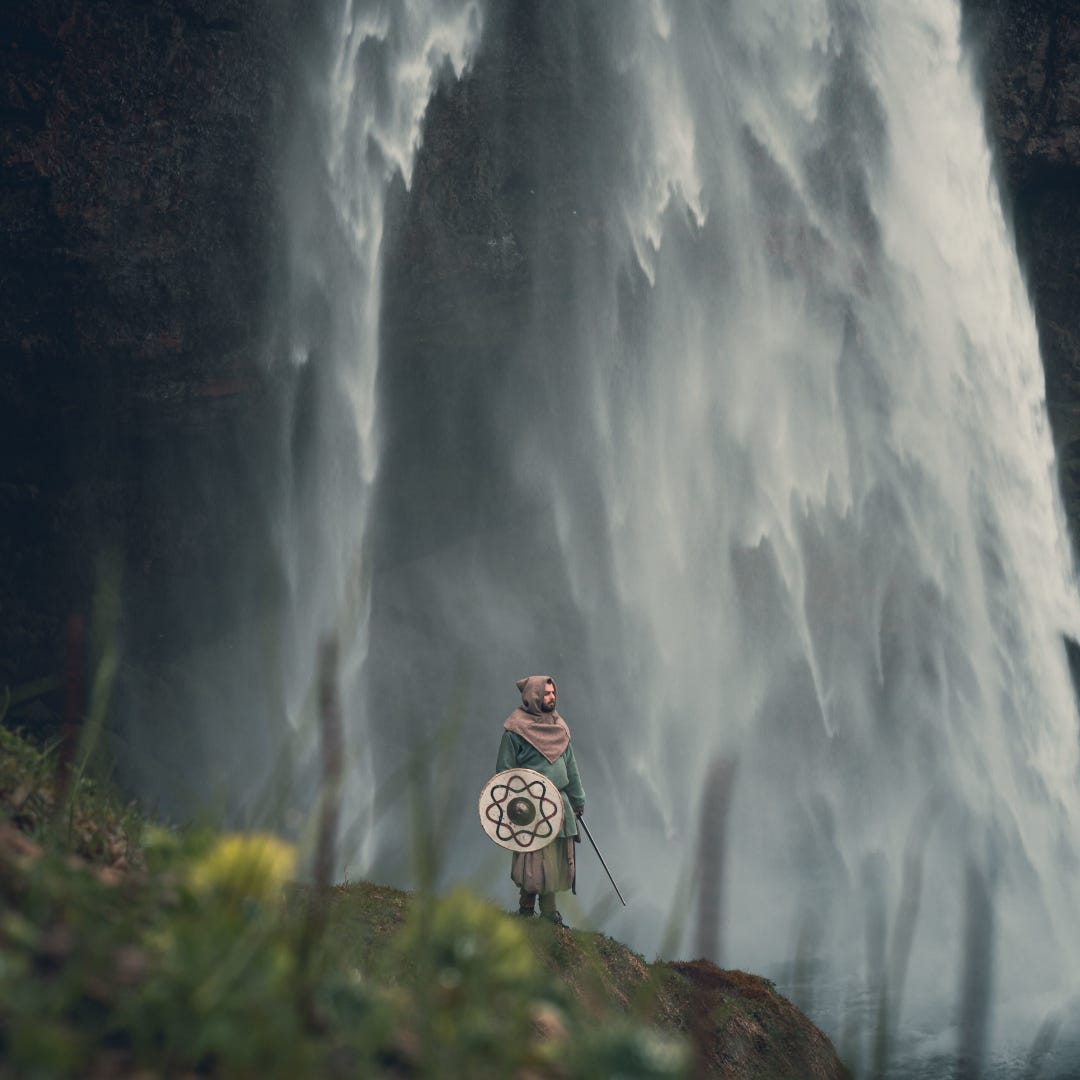
Harnessing personal power
Think of mægen as a single quality that pervades your entire being. It should not be isolated as only physical might. It includes psychological strength. It also includes spiritual power. Everything in the universe has its own mægen, its own personal power. You are born with a certain mægen and carry this through life, building upon it or diminishing it through your actions. Noble deeds increase it, misdeeds decrease it. Who you associate with shapes your mægen—powerful positive individuals and groups will expand it, while negative associations will reduce it.
In the Northern mythos, mægen underlies the power of great wizards, seers, kings and heroes. Strong mægen brings success, effectiveness, and prestige. While modern culture tends to avoid directly talking about personal power in this way, it has always been a key to any successful human life.
Think about our modern heroes—those who courageously put themselves in danger to protect others; the soldier in battle, our police and frontline emergency services personnel, the random bystander who stops an attacker in a public shopping mall (and becomes famous overnight). We naturally respond to such courage with great honour and respect. We exalt such people because they have demonstrated their mægen. Mægen is honourable power. It is not brutish force or mere muscle.
It is also psychological strength. Ernest Shackleton and his team survived 633 days in and around Antarctica before returning to civilisation. Survivors of the 1972 Andes flight disaster endured 72 days of starvation and extreme cold in the mountains. J. K. Rowling persevered through poverty, depression, and multiple rejections when starting the Harry Potter series. These individuals realised their own power—their mægen—through such ordeals, while those with less would have quit. Any great endeavour requires mægen to endure the challenges, overcome obstacles, and succeed despite the odds.
Beyond the physical and psychological, mægen is spiritual power. Often less understood, spiritual power comes from individual integrity, self-awareness, and universality. Those rare individuals—the genius, sage, mystic, yogi, shaman, philosopher, or artist—who develop a direct conscious connection with existence become centred in the depths of their being, unshakeable in their true self. They access insights beyond the normal human range and create brilliant works to benefit the world. Such mægen is universal, bridging humanity with the eternal and the infinite.
This deeper mægen is applied pragmatically through attunement to natural law—to orlæg—where being is in accord with the greater patterns of nature. The wizard cultivates such power through self-awakening and their direct connection to the universe. This is the power of self-mastery, and provides a foundation for action and success in the world. At this level a person can appear almost magical, but this is more the result of understanding orlæg and having the capacity to act skilfully among it—known as wyrd, the art of becoming. We see this in stories where a wizard lives in harmony with the universe, speaks of things that may come to be, senses distant occurrences, has greater freedom to act, and so on—examples are the Brythonic tales of Merlin, Gandalf in Tolkien’s mythos, or Obi-Wan Kenobi in Star Wars. Today, we see similar power in the engineer who understands the laws of physics and is able build things that harness these laws to create seemingly magical effects—like a mobile phone to communicate over a distance.
Mægen is the root of all aspects of personal power. While it may be developed physically, psychologically, or spiritually, and expressed in many different ways, it abides at one’s core. The balance of great physical, psychological and spiritual power in an individual is extremely rare, and shows a complete, integrated mægen.
The modern dismissal of luck
That luck can be cultivated may seem an unusual idea to us moderns. Since the scientific revolution of the 16th and 17th centuries, we have come to view the universe as a chance arrangement of matter and energy set in motion 13.8 billion years ago, where we humans just happen to live on the one planet that met the right conditions for life, where that life has survived to this day through random natural selection. Astronomer Fred Hoyle gives the likelihood that matter could somehow arrange itself out of randomness into living beings as effectively zero, comparing this to the chances of a tornado ripping through a junkyard to create a perfectly made aeroplane. Biologists then countered this idea by stating that the evolution of life is not completely random, but builds (randomly) upon those traits that increase the chances of life surviving over billions of years.
Both these views are within the modern mindset, where the official narrative is that life in the universe is a meaningless, purposeless accident (with notable exceptions among some scientists and philosophers). In this framework, all your experiences of life’s richness and beauty—the insights, the pain and joy, the deep yearning, dreams, and reminiscing—along with those of billions upon billions of other people, are officially pointless. In a word: nihilism.
While some parents may be reluctant to tell their child that his or her birth was an accident, one must ask: Is the universe also this way?
Before you sink into existential ennui, recall how things once were. The notion of life as the result of randomness is a far outlier among the 300,000 year history of sapient humans. Every culture but the modern seems to have always considered the universe as purposeful, ordered, and sacred—with a few exceptions among schools of philosophical thought here and there. Even today, while a nihilistic worldview tends to dominate collectively, modern society itself is intermixed with many different worldviews from various religions, cultures, subcultures, and individuals. So while we may think that the modern view is just how things are, such thinking is limited to a single culture across a narrow slice of time.
How then did other cultures view the world? The creation stories of great civilisations tell how the world was made from the body of an original being—the Norse Ymir, Babylonian Tiamat, Vedic Purusha, and Chinese Pangu are prominent examples. But to really understand this requires stepping out of the modern framework and its reductionist view of mythology. Myth is closer to story, like a profound movie or book. It need not be taken literally for it to inspire, guide, build understanding, spark insights, and shape our world.
Furthermore, indigenous cultures worldwide—including Northern cultures—consider the universe to be widely populated by non-human people, spirits and forces that animate the natural world, including the land, sea, plants, animals, and celestial bodies, with whom we humans have an ancient kinship and reciprocal obligations. The indigenous worldview is often that of a living, inter-related universe whose existence is innately meaningful and built on individual and collective responsibility.
So when it comes to luck, the modern world teaches us to think of it as chance. Luck is just a random thing that happens to you. So when a rock falls off a cliff and hits you right on the head, that’s pure chance—and bad luck. The very concept of luck is treated suspiciously—it’s not something any rationalist would take seriously. Luck is replaced with randomness in the modern world, stripping the universe of agency and reinforcing its meaninglessness and our pointless role within that.
Yet our culture still carries vestiges of wiser times. We may talk of a person being born lucky, or that bad luck follows someone. These are ancient ways of thinking, and we must re-examine the modern nihilistic worldview to go beyond the idea of luck as random chance. The ancient understanding of luck opens the door to powerful ways of building beneficial momentum in your own life. This is encapsulated in the ancient concept of hamingja.

Luck is an ancient idea
In the Northern traditions, hamingja is the inherent luck that an individual carries. It is built through self-awareness and noble deeds and is weakened by dishonour, carelessness, and evil actions. It can be inherited or lent, is strongly based on one’s family or clan, and is passed across generations. One is born with a certain hamingja and how one dies reflects what they have done with that across their life.
Similar concepts of luck are found around the world. Luck in the ancient view is built upon relationships with natural and spiritual forces, personal agency and fate, ritual, and ancestral influence. From the Roman Goddess Fortuna to the Tibetan རླུང་རྟ་ (lungta, ‘windhorse’) and the Chinese 运气 (yùnqi, ‘fortune’), to the many terms for luck among the Siberian, Melanesian, African, and Native American peoples, luck was never about random chance. It was always about relationship, balance and how one acts.
While it is easy for us moderns to dismiss these concepts as irrational superstition or magical thinking, we should be careful in ignoring such a widespread understanding of our ancestors that is extremely old, predating written records. Our modern mind tends to want to understand such concepts literally, and when this seems nonsensical, dismiss them. But they are mythopoetic concepts, interweaving powerful stories, primal archetypes, and deep symbolism into a creative, sacred, experiential relationship with our present. We have become so accustomed to thinking in the modern way that we remain closed to other ways of seeing. Put simply, we can consider such concepts as hamingja (and mægen) as creative tools for self-transformation.
Those with greater personal power and spiritual attunement tend to have greater hamingja. They have increased vitality and act with honour. Things tend to go their way, or if not, they have the confidence to face and surmount any obstacles. Such people are often exuberant, have high agency, and uplift those around them.
Hamingja is relational
Hamingja is deeply relational. It is continually shaped by how we act toward other beings (human or otherwise). Luck is realised when those beings respond by offering something beneficial—a physical gift, knowledge, protection, health, or favour. Examples include an ancestral spirit protecting a family member, a plant offering its healing properties, or a friend deciding support you after a hard day.
The realisation of hamingja has two criteria. The first is that someone gives something. The second is that the person who receives that is deserving. Where the gift is tainted, forced, or insincere, or the receiver is not deserving or ungrateful, the luck will not be pure—it will carry some kind of catch or will come at a price. The ancient cosmos works through natural laws, orlæg, which balances all things accordingly.
Those with great hamingja seem to have luck follow them wherever they go. The world bends to them. Because of their actions, they carry an aura of good influence, which others recognise and respond to more positively. Hamingja can similarly be weakened through bad relationships. If you act poorly towards another, you’re unlikely to gain their favour. And if you are filled with hatred and resentment, your ‘bad vibe’ is not going to do you any favours among other people. And in an animistic universe, which the Northern mythos presents, the results of both positive and negative hamingja apply across many layers of relationship, including the natural elements, plants, animals, humans, and other beings (gods, goddesses, giants, wights, elves, dwarves, house spirits, water beings, etc.).
Combining power and luck
Mægen is absolute. It is cultivated through actions aligned to reality. When you act truly and in alignment with the universe, you have the absolute power of the universe behind you. Whenever you act at odds with existence, power is diminished and things tend not to work. The key here is self-awareness—the experiential recognition of yourself as innately and uniquely part of the whole. Meditation is the best practice for self-awareness, and from this comes the capacity to act as your true self.
Hamingja is cultivated through how you act towards others. It is realised in how other beings act towards you. The power of your deeds may be enhanced or constrained by other beings in various ways. Having more power, in the sense of overpowering others, may not be the best way to achieve what you want. Mistreating others will inevitably harm your hamingja and will have broader reputational consequences, which will further diminish your hamingja. Likewise, not committing to action and instead relying on your luck, including the good will of others, to achieve an outcome is more likely to be ineffective. In such passivity, you give away your agency by not exercising your mægen.
When hamingja combines with mægen they increase the ‘gifts of the gods’—in the Northern mythos, these are óðr (inspiration), önd (breath), lá (vital fluids), and litu goða (good hue). In large measure, these create heroic power. They empower action and provide the capacity to endure difficulties, overcome obstacles, and persist until the end. The old stories tell of the gods testing heroes, withholding something from them or deliberately making a task harder. We can see this as a metaphor for how the universe responds when you take on a large difficult goal. Rewards do not come easy, they take time, and often the difficulties are necessary to bring out the best in you. If you started a great journey and instantly without effort reached your end goal, you would not have changed and grown as a person. You would not know what you are capable of, and you would most likely not value the result. There is wisdom in the difficult ways of the universe.
And there is an art to cultivating mægen and hamingja, and to combining them wisely. Here, we have explored these two concepts as a basis for personal power, agency, and success. Much more could be written on them, but it is their practice that brings the real experience and understanding.
A practice article on this topic is on the way. Subscribe to Wizardry Sphere for free, or as a paid member for full access.
Disclaimer: Wizardry Sphere content and tools support the personal practice of developing wisdom and self-mastery through reflection and philosophical exploration. They are educational and inspirational in nature. Individual results vary and no specific outcomes are guaranteed. This material is not a substitute for professional advice.
www.wizardrysphere.com | Terms and conditions | Privacy policy
Copyright © 2026 Genius Authoring Pty Ltd trading as Wizardry Sphere | ABN 85 669 120 978