


What we know about the ancient world is often limited by present conventional thinking.
Our ancient ancestors understood the world as a mystery. Not as superstition because we didn’t know any better, but as a deeper philosophical acceptance that we can never truly know everything. Nature is infinite, while our knowledge is directional and mostly utilitarian, and time has a way of eroding knowledge that no longer fits our needs. Our world paradigm has shifted dramatically over the past five centuries. So has our knowledge base.
Subscribe to Wizardry Sphere for free, or as a paid member for greater access. Support our work to build wisdom culture for the emerging world.
As an example, take modern city dwellers versus an ancient indigenous tribe living in the wilderness. Both have different sets of knowledge that support their survival, social arrangements, culture, and traditions, founded upon their particular mythological framework. Armed with only this knowledge, each group would likely find it difficult to survive in the others’ environment. Yet those city dwellers were once an ancient indigenous tribe themselves. Over time their mythological framework shifted with society’s direction and changing needs: from animistic immersion in a sacred natural pagan world through a hierarchical Classical-Christian-Cartesian order to the atomised post-modern nihilism that appears widespread today.
The result of this shift is that now when we think of the mystery of our earliest ancestors, we rarely access it from their worldview. Our own knowledge infiltrates who they were, what they did, and why they did it. We end up only seeing ourselves in them, and may wonder why they were so primitive.
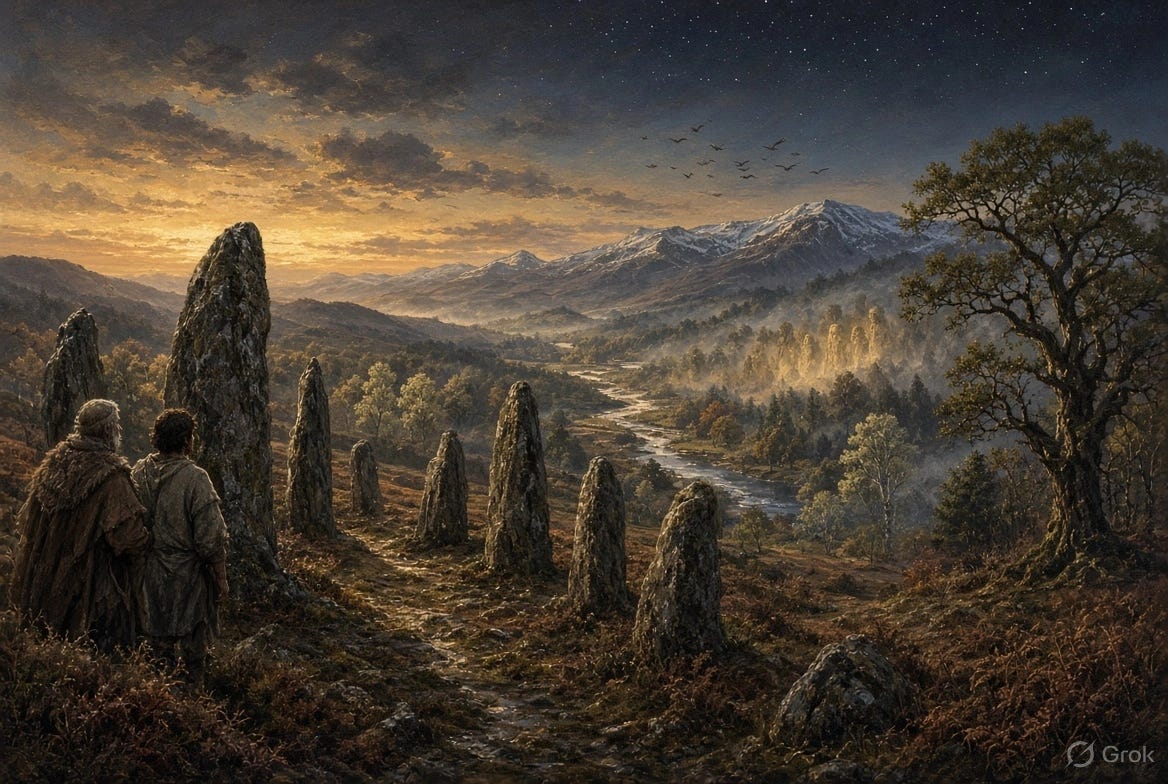
This limited framing dissolves when we take a larger view of human existence, which begins by contextualising our present society as a tiny sliver of human history. To think we are the most knowledgeable human society that has ever lived is hubris. Yes, we know a lot, but it remains within the constraints of our present knowledge framework. True knowledge has widespread utility and enduring relevance. Yet some of our present knowledge will be out of date in one hundred years—perhaps even ten years.
The real value in what we know is our system of knowing it, which is largely a cerebral activity enhanced by technologies built upon modern science. This system generates knowledge. It moves forward with us. Yet it also renders older knowledge obsolete—if only because our technology has taken on a greater load. It is a useful system, yet if we lost all our technology tomorrow, how much would we know in a practical way?
The hard sciences provide the foundation for our technological advancement, which couples with the Enlightenment paradigm that we are progressing toward an ever-improved world. According to sites such as Human Progress, there is much evidence that many things on Earth are getting better. Today, this progressive Enlightenment paradigm overlaps with mythologies that also see time as a linear progression towards an ultimate utopia, such as Christian or Marxist worldviews. Interestingly both Christianity and Marxism posit that a rupture (a judgement or revolution) is required before humanity can reach that perfect state. History shows us this rarely turns out for the better.
In contrast, the Enlightenment, fuelled by science, tends to view progression as smooth, gradual, and without end. However, science should be distinguished from the Enlightenment. Science is rightly a method, rather than a linear narrative.
While I understand these are big topics and many nuances exist, the main point I am making here is the underlying mythology of linear progression. The linear worldview is an inevitable move from A to B.
The opposite but equally linear view is linear decline, a move from B to A. The universe started as paradise at the dawn of time, then everything got worse, sometimes through declining world ages, and here we are, fallen, sinful degenerates. This view on its own is less common. More often decline is mixed with linear progress. Christianity has both a fall from Eden and a future paradise, but remains a linear trajectory. And while modern science is a primary engine behind linear human progress, it also theorises the Heat Death, where the fate of the universe is extrapolated to gradually expand, cool, and darken, as the stars die and matter and energy settle into a state of maximum entropy after about 10100 years—a long slow linear decline.
But does nature ever move as a unique historical plot toward a known final state? Natural systems are complex, interconnected, and rhyme over cycles. Their beginnings and endings are measured arbitrarily within a vaster cosmos. While our calendars count the years linearly through a series of identical days and months, numbering them from a designated year-zero, time in nature does not move in this way. Nature turns in rhythmic cycles of growth, decay, and renewal, not under some clockwork system or narrow ideal narrative, but as the phenomenon itself.
Such cyclical views of time are found among Hindus, Buddhists, Taoists, Classical civilisations and many indigenous worldviews, including the Northern traditions. These paradigms are far older than linear-progressive views. They treat time as the recurring natural cosmos, which often includes an underworld and upperworld where the dead go to live until they are reborn in this world. The seasons, generations, and greater sun cycles and world ages move as a rhythmic pulse, not repeating exactly (unlike Nietzsche’s die ewige Wiederkunft, ‘the eternal return’) but eternally rhyming, just as history tends to do, with an underlying mythic reality. This mythic reality is the deep narrative tapestry that explains the cosmos and one’s place in it through story.
In these ancient and indigenous views, the past becomes the ancestors and the land—nature’s living patterns of story and belonging. The Northern mythos understands this process through the concepts of ørlög and wyrd. Ragnarök in Norse mythology is a turning of time, not a final exit into a manufactured paradise. In this way, time moves with the cycles of life, not as a planned project. It is based on direct observation and experience of nature, not abstracted ideas of some distant perfection.
Of course, people will have different reasons for believing a particular paradigm about time, how it moves, and where it is ultimately going. But we should be aware that linear views of time are not the universally adopted view. Viewing time as the future ahead, the past behind, and progress or decline as we move through it is the exception to most cultures across human history.
Linear cultures still plant by the seasons, and cyclical cultures remember unique events of the past and hope for a better future. The crucial difference is that linear culture tears up the old for the sake of a promised future. And while we may not know the future, we can look to the past for how often widely-believed predictions, prophecies, and promises actually occurred—which is basically zero for dated events. We can also recognise that some linear narratives remain open by design—the second coming that never arrives; every failed revolution is still ‘the transition’.
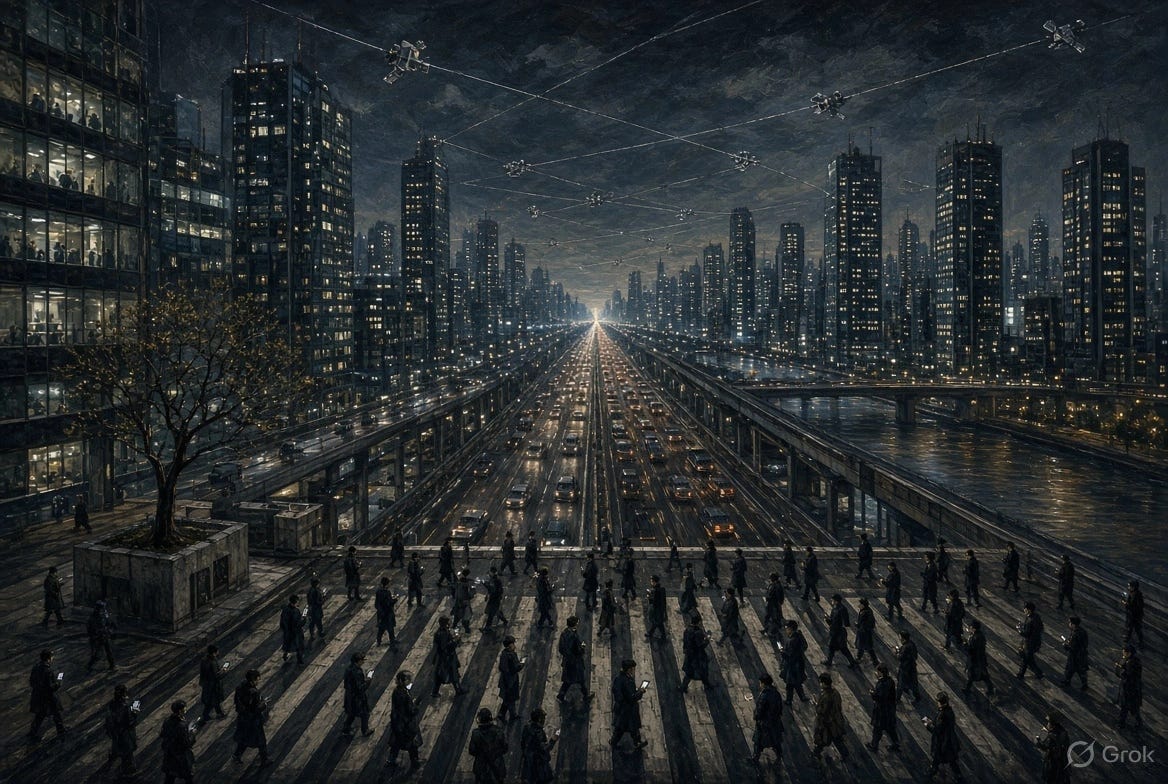
The exception here is science, which has a demonstrable track record of human progress within its own domain and remains subject to revision based on new discoveries. While science has yet to address all human problems (greed, envy, death, what is consciousness? and the like) and has also brought with it new problems (nuclear threats, bio-weapons, materialistic nihilism), it nonetheless presents a method for improving humanity without the ideological need to believe in a coming utopia.
Science leaves room for being realistic; for the individual to think for themselves, adopt different philosophical or religious points of view, and critically test their own thinking. The same cannot be said for some religions and ideologies. Salvation narratives punish critical questions, while a method that expects revision does not. An inquisitive, pragmatic, broad-minded approach to science presents the possibility for genuine human improvement in certain areas. This is not the case, however, for the dystopic side of science, the cold positivist-materialist approach that seeks absolute control over nature, denies anything science cannot grasp within its methods, and views its conclusions as superior truth.
We need to be wise in this regard. A human culture of wisdom is required to properly orientate the power of science and technology, to prevent it from overriding our humanity and our need for beauty, meaning, purpose, belonging, and coexistence with the natural world. Science cannot fulfil every human need. Problems arise when science attempts to override cultural, spiritual, religious, or philosophical traditions. These serve distinct purposes—science explains the what and how of matter and energy, for utilitarian purposes; the others encompass deeper aspects of our humanity. When such distinctions are properly understood, the scientific method can (and does) coexist with traditional worldviews. We can have a future that is inclusive of all that is human.
In trying to understand that long-lost world using our own linear measures and ways of thinking, we may miss the point: they didn’t use those ways. They acknowledged the world as mysterious—riddled throughout their myth and lore. We may think we know better because our knowledge is fixed, certain, rational. But in thinking this way, the world becomes a lifeless object to conquer. Only we haven’t conquered it. We have swallowed ourselves in the world we have created from our worldview. We become the conquered world we conquered.
Our own ancient mythological foundations have been forgotten over time, lost in the noise of politics and overridden by the blanket control of mechanised society. In such a world there is no longer mystery, only certainty within the constraints of the known; beyond that, it’s expected that the untamed will one day be conquered (assumed known and ideologised) or otherwise considered void. The glaring blind-spot here is that while technology advances and the official narrative is ideologically intact, the real human nature is ignored, and builds up until it bubbles over. Ignoring our deeper humanity is not a stable position. For civilisation to endure, we need a paradigm that encompasses all that we are. We need a sense of the ancient future: the coexistence of ancient wisdom with future technology.
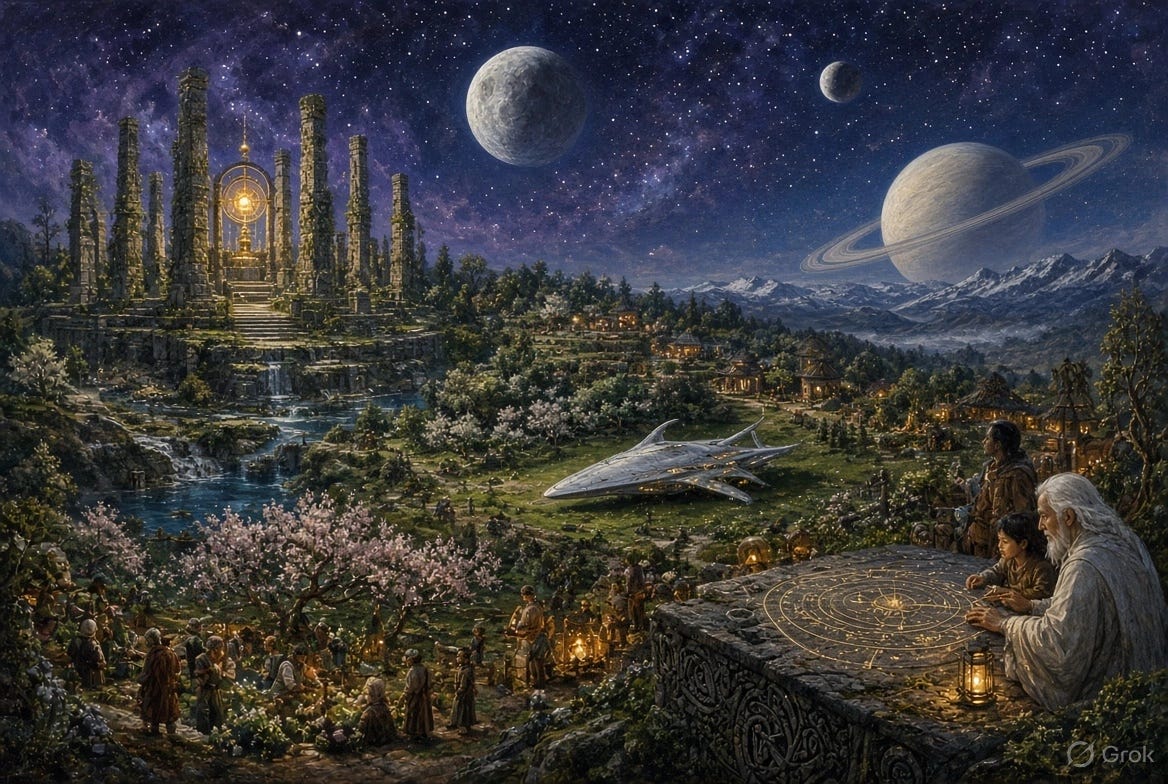
The man with the wisdom of the ancient future does not imprison himself in a limiting worldview. He is free because he recognises the liberating qualities of nature: mystery, beauty, power, perfection, intelligence—and aspires to cultivate these (and other qualities) in himself. He understands science in the context it is designed for—as a tool to understand and shape the material world through technology, not an all-encompassing worldview. He knows the complete human being is far more than science in its current paradigm can ever understand. He understands that wisdom must guide science.
Our civilisation must include depth, meaning, and belonging to the greater universe. We must harmonise with nature in its fullest sense—not merely as matter but as living spirit, autonomous interconnected existence. Technology, however useful, must be encompassed within a greater worldview and applied wisely for it to be sustainable. It must coexist with humanity and with nature over greater periods of time, which is essential if we are to become an interstellar species. Widening our thinking allows us to recognise that ancient people also had their own sophisticated understandings of the world, in ways different to our own.
As we mature as a species, we must mature our view of time and our place in the cosmos. Progress is not simply linear; ‘out with the old, in with the new’ is very shallow, short-term thinking about our human nature. Attunement to a cyclical paradigm of time is more likely to bring sustained permanence to civilisation. We no longer run on the vapours of endless progress, but prepare for the inevitable winter, and trust that spring will follow. Our ability to sustain our civilisation across natural cycles depends on our ability to survive the recurring disruptions within such cycles.
Mythologically, humans have always attributed such disruptions to cosmic events—the acts of primordial beings, the gods and goddesses, dragons, and giants. These should not be taken literally in a material sense. They are powerful stories etched into the deeper collective human psyche—the enduring wisdom of collective mythology. This wisdom has evolved with humanity from our deep prehistory and shapes the foundational values of civilisations.
Current linear paradigms that promise a future utopia or dystopia are the modern equivalent of such myths. They attempt to orientate us to a greater story about our existence, but their scope is often limited to materialism or politics. We should recognise that by thinking in linear terms, modern humanity is an outlier from most cultures that have existed before us. Modern linear mythologies lack the hard-won organic wisdom of the ages. Our attempts to debunk all other mythologies while we remain blind to our own doesn’t make us more advanced as a civilisation—it simply shows that we do not see ourselves deeply enough.
What is important is that we awaken to our mythic consciousness (our mythos), while awake to our powers of logic and reasoning (logos). The two need not contradict—each brings a complementary power to being a complete human being. The stereotypical primitive whose superstition overrides their reason is no better than the modern whose abstract reason overrides their deeper mythological being. If we are to endure the ages as an interstellar species, we must awaken and integrate both logos and mythos, emerging science and ancient wisdom. We must become complete human beings if we are to build an enduring civilisation. This is our ancient future.
Subscribe to Wizardry Sphere for free, or as a paid member for greater access. Support our work to build wisdom culture for the emerging world.

Some images in this article are generated by Grok AI.
Disclaimer: Wizardry Sphere content and tools support the personal practice of developing wisdom and self-mastery through reflection and philosophical exploration. They are educational and inspirational in nature. Individual results vary and no specific outcomes are guaranteed. This material is not a substitute for professional advice.
www.wizardrysphere.com | Terms and conditions | Privacy policy
Copyright © 2026 Genius Authoring Pty Ltd trading as Wizardry Sphere | ABN 85 669 120 978