


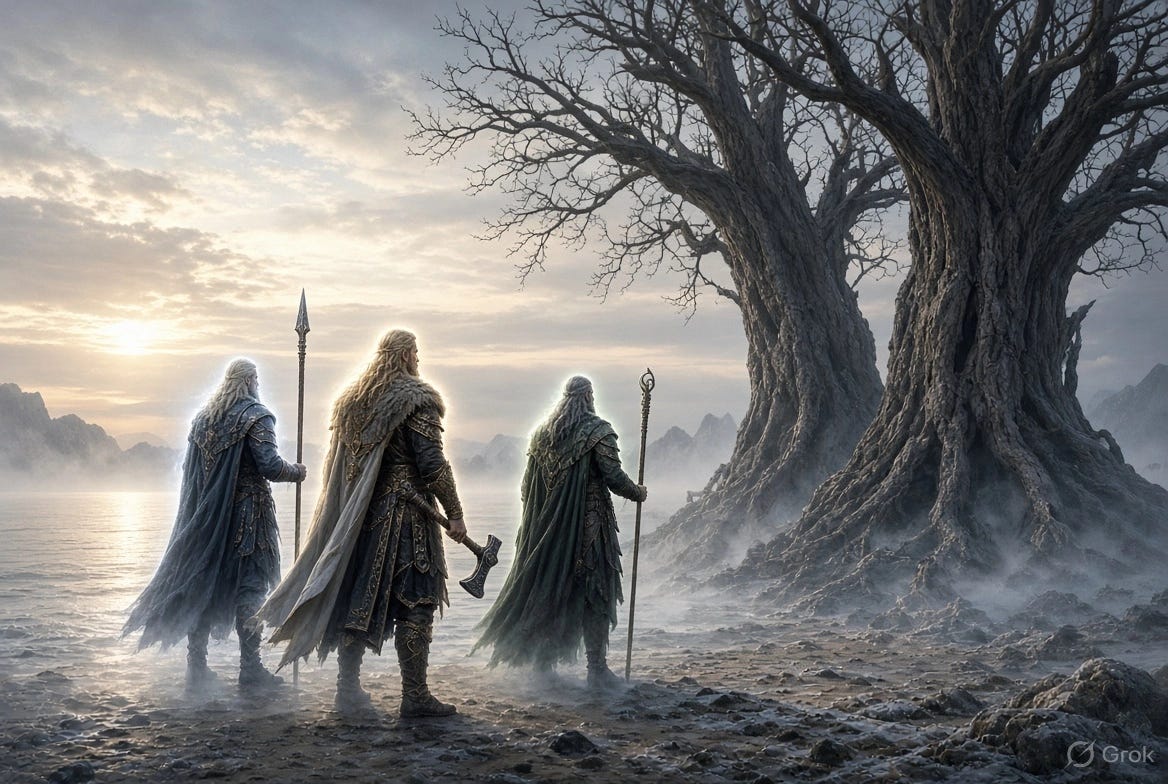
The three mighty and vibrant gods Óðinn, Hœnir, and Lóðurr are one day wandering the countryside when they encounter two trees by the seashore. These trees are Ask and Embla, who are to be the first man and the first woman. But they are devoid of purpose and destiny. Seeing this, Óðinn gives them vitality (önd), Hœnir gives them inspiration (óðr), and Lóðurr gives them vital fluids (lá) and good complexion (litu góða). They become the first humans. (From the Völuspá 17–18, a prominent poem within the Poetic Edda.)
These three ‘gifts of the gods’ to humankind can be taken as a mythical understanding of the animating faculties of human nature. They have broad meaning and multiple-layered relevance, making them important foundational concepts for understanding one’s own nature as a human being. This article will explore the meaning of each of these gifts, and how they can promote the development of one’s greater human potential.
Subscribe to Wizardry Sphere for free, or as a paid member for greater access. Support our work to build wisdom culture for the emerging world.
Óðr
Óðr refers to the mind, soul, wit, and sense—the basic human faculties for functioning sentience in the world. It represents mental acuity and focus. And it has more extraordinary associations with intensity, inspiration, fury, madness, and poetry.
Those unfamiliar with poetic tradition may wonder why poetry is included here. The ancient poets were essentially vessels for higher powers, which they opened themselves to through various practices, similar to the shamans of other cultures. Hence we have the ancient Roman term furor poeticus (‘poetic fury’) and the ancient Greek equivalent ποιητικὴ μανία (poietikē mania, ‘poetic mania’), which Socrates, in Plato’s Phaedrus, identifies as one of the four kinds of divine madness.
We can see this poetic madness, fury, and inspiration across all ages of humanity, from the ancient shamans to the inspired bards to the energised singer on stage. Lyrics of songs are closely tied to poetry. When the music takes over, something changes within—an exaltation, a state of flow, extreme bliss, fearlessness, a sense of wholeness, and a deep connection with everything else. This is the result of increased óðr. It is an intensity of simultaneous presence and transcendence.
It is also related to the Greek ἐνθουσιασμός (enthousiasmos), which is the source of the English word ‘enthusiasm’. The word literally means ‘having a god within’ (en + theos). And we can see the connection here with óðr as the gift from the god Hœnir. At its most fundamental level, óðr connects the human with the infinite, inspiring a daimonic intensity in all that one does.
Yet an excess of óðr can be hard to bear. It can be too intense, leading to excess energy and stress on the mind and body. The analogy is that of driving a higher voltage through a circuit not built to bear it—something will eventually break. Mystics, shamans, yogis and the like all know such things, which is why they spend many years training their bodies and minds to become stronger in order to handle the intense energies of the sacred.
At the same time, insufficient óðr makes one dull, lethargic, and depressed. Such people appear defeated before the day even starts and they have a lot of inertia when it comes to getting things done. In the Nordic myth, the two trees were of the vegetable kingdom before the gods gifted them with óðr and the other gifts.
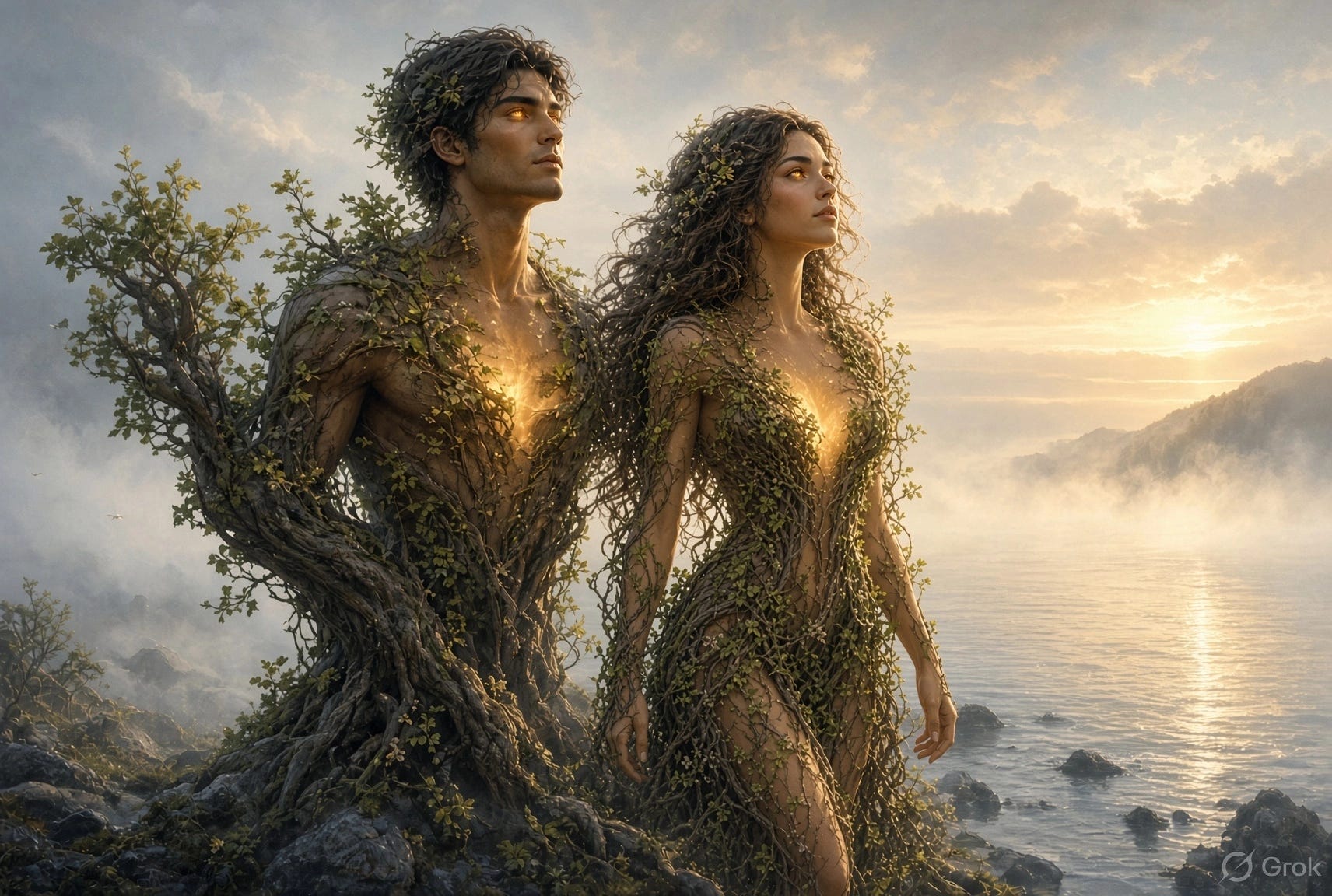
Óðr has a common etymology with the name of Óðinn, the ruler of the Aesir gods. Óðinn is the wandering wizard who is inspired by the deep mysteries of existence.
Óðr is generally related to the Vedic तेजस् (tejas, ‘radiance’) and the ancient Chinese 神 (shén, ‘spirit, clarity, presence’). It is the fire of consciousness applied through words and action. It is seen in great geniuses throughout history, who experience peaks of óðr during their most profound discoveries. It can exalt a person to perform extraordinary deeds, yet must be tempered with balanced vital energy and good health—the first of which we will now explore.
Önd
Önd is life force and vitality. Similar concepts are represented in a wide range of ancient cultures: Sanskrit प्राण (prāṇa), Chinese 氣 (qì), Greek πνεῦμα (pneuma), Latin spiritus, Japanese 気 (ki), Korean 기 (gi), Egyptian ka, Finnish henki, Polynesian mana, and so on. The concept’s pervasiveness highlights a common understanding of life force across the ancient world, prior to the modern reductionist materialist way of seeing. Yet the concept lives on in those cultures that uphold a vitalistic understanding of the universe.
On an individual level, önd is inherited and cultivated vitality. Increasing it brings energy, health, and power of action. Breathing practices are one of the main ways to develop önd, but önd itself is not simply the respiratory system; it underlies all the body’s systems, including at a cellular level, and is the vitality within the mind and deeper consciousness. Önd for the individual originates at the deepest core of the self, as the living energy of the individual soul. Individuals who tap into this inner power gain greater vitality at all levels of being. They exude life and have seemingly inexhaustible energy. We can recognise such people as having great önd.
Personal power (mægen) and cultivated luck (hamingja)—see our article on these topics—are closely related to an individual’s önd. A person with high mægen and hamingja will similarly have great vitality, power of action, and resilience, increasing the likelihood of success in their endeavours. Those who overflow with intensity and vitality, who are inspired and aligned with their passion and purpose, and who are attentive to their own health, wholeness, and integrity become vessels for powerful energies to apply through their action in the world. They make themselves worthy of the original ‘gifts of the gods’ and may have a dynamic influence upon the world.
Beyond the individual, önd pervades all of nature and animates the entire universe. It is the energy underlying all forms—with form itself being more closely related to lá and litu góða in the context of this article, which we will discuss soon.
Önd as life force goes beyond the scope of living things being limited to plants, animals, and human beings. The Northern cosmos is itself a living form, the great world tree Yggdrasil, upon whose branches all the worlds sit. The Earth is the living Goddess Jörð, and innumerable vættir (‘wights’) inhabit natural formations. These natural formations do not exist as isolated objects. They are an integral part of the natural world in which they exist, exchanging energies with their surroundings, performing various functions, and in some cases forming especially powerful focal points for those energies. This way of understanding the animistic natural world is shared among indigenous cultures worldwide.
This mythic view presents an animistic universe, where everything is alive in its own way and manner. Rocks for example, while not living as we commonly understand ‘alive’ today, nonetheless have their mineral and crystal structures, where chemical, radiogenic, elastic, thermal and piezoelectric energies move within and through them according to the patterns of nature. Önd can be understood as the movement of energy within rocks, and within every other natural material.
Önd also connects everything in existence, as the underlying awareness of all that is, shaping the becoming of all things (for more on this, see our article on ørlög and wyrd).
Lá and litu góða
Lóðurr’s gifts of lá (vital fluids) and litu góða (good hue) can be treated as a single cluster. Lá represents embodied vitality and is associated with warm blood (a sign of the living) and may be associated also with the shoreline or a liquid film, denoting the boundaries of the body. Litu góða is the complexion of a living being; the skin’s brightness, a rosy hue. The difference between önd and these two is that lá and litu góða are embodied, thus representing the form rather than its underlying energy. The human body when alive has a certain warmth and lustre to it; all the more so when it is healthier. These two are not limited to physical form; psychologically, they represent the warmth and hue of the mind and heart.
Being associated with blood and the boundaries of blood, they also represent the family and the extended clan. As the most embodied aspect of the three gifts of the gods, they tie one to a specific ancestral lineage, whose genetics one inherits, and often whose culture one is raised within. Complexion relates to appearance, and more broadly lá and litu góða highlight the likeness in appearance of family members, not simply as physical features, but also as the underlying vitality and qualities of this appearance.
A vital complexion is a measure of good health, and these two reflect the physical and psychological health of the individual. When sick, a person can appear pale or dull, frail and lacking. The health qualities of these gifts are a much bigger topic than can be covered here, although it is interesting to observe the relationship between what we typically call a person’s natural glow and their health. A person’s complexion is also closely related to certain emotions—we may blush when embarrassed, become red with anger, or pallor when frightened. We could also suggest that a natural glow highlights human goodness in a person, another topic beyond this article’s scope. And while the eyes can be said to have a sparkle or a shine in a healthy person, this is more likely to reveal a person’s óðr, as a measure of high inspiration, than their lá and litu góða—the eyes being the window to the soul.
In terms of equivalents in other cultures, we have the Sanskrit ओजस् (ojas) and the Chinese 精 (jīng), both indicating the underlying stamina of a person, responsible for their glow, inner joy, capacity for endurance, and ability to ward off ill health. The Greek χρώς (chrōs) also has a similar meaning, as a measure of healthy colour and humoral warmth, as well as meaning the body or frame. This is not to say these concepts are identical to the Northern equivalent. There are differences. The important point here is that they often form a triad with the previously discussed equivalent concepts, as we will soon see, which can be very useful as a framework for self-mastery practices.
Integrating the three gifts
These three ‘gifts of the gods’ bring mental acuity, vitality, and natural glow. They make us human in the sense of being animated, sentient, and warm blooded. Lacking any one of these means we are either dead, unhealthy, or incapacitated. So the Old Nordic story makes sense in this perspective, and there is much more that could be explored on these three.
The three gifts also have a general cross-cultural alignment with a mind–breath–form triad. Mind is óðr, breath is önd, and form is lá and litu góða. The Vedic triad of tejas, prāṇa, and ojas, or the Chinese triad of shén, qì, and jīng, broadly corresponds with these three. They are not precise equivalents, but in all cases they show a system for practical development. Those who have practised yoga, ayurveda, tai chi or qi gong will be familiar with these other concepts. The Northern set is of the same nature, while also unique in its cultural orientation. Likewise ancient Greek and Roman cultures would have similar systems, as would many other cultures—which goes beyond the scope of this article. The Vedic and Chinese systems are very well developed and can be useful for understanding areas where the Northern, or other, cultures have fragmented knowledge, systems or practices.
In due course, Wizardry Sphere will write an article outlining practices for developing these three gifts of the Northern mythos.
Epilogue: the value of ancestral lore
We must remember that traditions are living things to this day, not rigid relics of our past nor fantasies to mimic. They are part of us, woven into our genetics, into our strengths, weaknesses, hopes, fears, and dreams. Each of us is a continuation of our own ancestral traditions, even if we are not aware of the extent of this. A line continues from the original ancestor down through the many many many generations to you today, and it is important to honour the gifts and self-sacrifice your ancestors made so that you can exist.
One way to do this is to understand the ancient lore of your people, because for most of your collective ancestors’ existence, that is what they understood. Such knowledge over many generations has survived the test of time—else you would not be here—and you carry this primal understanding in your own body. It is only very recently that we modern humans have diverged from that ancient foundation of lore that served us for hundreds of thousands of years living with the natural world. And the enduring wisdom of our ancestors will continue to strengthen us as we face new challenges into the future.
Yet we need to be creative with the wisdom of the past for it to be useful today and into the future. Some people prefer more fixed interpretations of the ancient lore. Wizardry Sphere prefers to apply wisdom creatively, which is why some of what we write goes beyond historical tradition. This is nonetheless an adaptation based on the author’s wide-ranging study and decades of practical experience.
Wizardry Sphere is sharing these foundational concepts for the world ahead. You may find a way to adapt them to your own daily practices and in doing so, frame your self-mastery within a deeper lore that resonates with your own physical body and heritage.
This is not a return to the past; it is about building an enduring culture of wisdom for the future. It is the wisdom of the ancient future, empowering individuals toward their own self-mastery, aligning each to their embodied ancient heritage, to further human flourishing on Earth and beyond.
Subscribe to Wizardry Sphere for free, or as a paid member for greater access. Support our work to build wisdom culture for the emerging world.
Some images in this article are generated by Grok AI.
Disclaimer: Wizardry Sphere content and tools support the personal practice of developing wisdom and self-mastery through reflection and philosophical exploration. They are educational and inspirational in nature. Individual results vary and no specific outcomes are guaranteed. This material is not a substitute for professional advice.
www.wizardrysphere.com | Terms and conditions | Privacy policy
Copyright © 2026 Genius Authoring Pty Ltd trading as Wizardry Sphere | ABN 85 669 120 978